

Fish Model Create API Integration Instructions
This interface is based on the Fish Audio Official Model API and is used to create a reusable cloned voice model based on an audio sample. The address is POST https://api.ai.moses.day/fish/model.
If you only need to temporarily use a reference voice, there is no need to create a model; you can directly use the
referencesof the Fish TTS API for one-time instant cloning. For paginated retrieval of existing voice types, please refer to the Fish Model Query API; for querying details of a single voice type by_id, please refer to the Fish Model Get API.
¶ Application Process
To use the Fish Model API, first obtain your API Token from the Mai Console for future use.
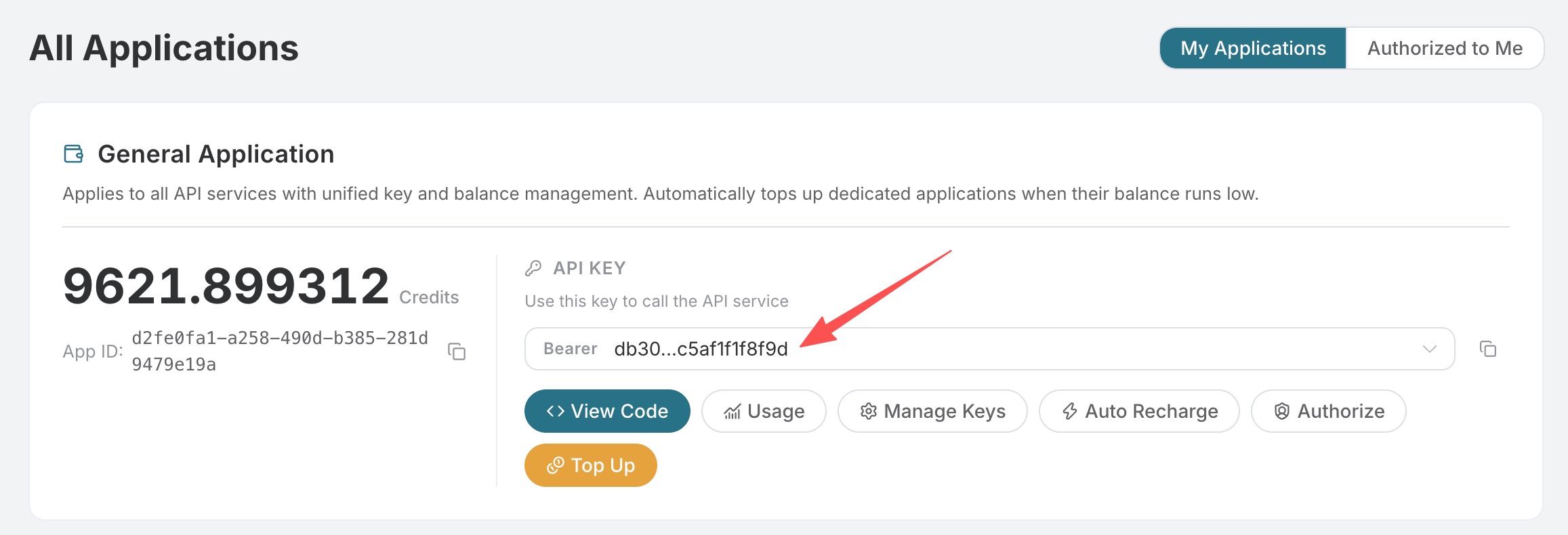
If you are not logged in or registered, you will be automatically redirected to the login page to invite you to register and log in, and will return to the current page upon completion.
One API Token can call all services on the platform, and there is no need to apply separately for each service. The first application will grant a free quota for a trial experience; when the quota is insufficient, you can recharge the general balance in the console.
📘 Complete documentation: Fish Model API →
¶ Request Body Fields
| Field | Type | Required | Description |
|---|---|---|---|
title |
string | Yes | Voice name, used for identification in the console list. |
voices |
string | Yes | HTTP(S) URL of the audio sample (single string, not an array). This interface does not support multipart/binary uploads; please place the audio in any publicly accessible object storage first. |
description |
string | No | Voice description. |
cover_image |
string | No | Cover image HTTP(S) URL. |
tags |
string[] | No | Public library search tags, e.g., ["male","narration","zh"]. |
texts |
string[] | No | Reference texts corresponding to the samples (used for correcting pronunciation). |
enhance_audio_quality |
boolean | No | Whether to enhance the audio quality of the samples before training. |
generate_sample |
boolean | No | Whether to automatically generate a sample audio after training is complete. |
The fields are completely consistent with the upstream; please also refer to the Fish Official Documentation.
¶ Example: Create a Private Cloned Voice
curl -X POST 'https://api.ai.moses.day/fish/model' \
  -H 'authorization: Bearer {token}' \
  -H 'content-type: application/json' \
  -d '{
    "title": "My Cloned Voice",
    "description": "A Chinese voice cloned from a podcast recording",
    "voices": "https://example.com/sample-voice.mp3",
    "cover_image": "https://cdn.acedata.cloud/e724d7f13d.png"
  }'
Note:
voicesmust be a string (single audio URL), not an array. Passing it as["..."]will be rejected by the upstream.
A successful response directly returns the ModelEntity object from the Fish platform (the following is the smallest usable voice we have tested, with some long fields removed for readability):
{
  "_id": "e5c6db52c3ed417f9cb2e5a33fb04667",
  "type": "tts",
  "title": "copilot-smoke-test",
  "description": "smoke test from api.acedata.cloud",
  "cover_image": "coverimage/e5c6db52c3ed417f9cb2e5a33fb04667",
  "train_mode": "fast",
  "state": "trained",
  "tags": [],
  "samples": [
    {
      "title": "Default Sample",
      "text": "Master, [with a firm tone] I have really had enough of the cold days on this mountain!...",
      "task_id": "6a1bf398dfae49dca0e23159214342a0",
      "audio": "https://platform.r2.fish.audio/task/6a1bf398dfae49dca0e23159214342a0.mp3"
    }
  ],
  "created_at": "2026-05-10T03:52:55.601000Z",
  "updated_at": "2026-05-10T03:52:55.601000Z",
  "languages": ["zh"],
  "visibility": "public",
  "default_text": "Master, [with a firm tone] I have really had enough of the cold days on this mountain!...",
  "like_count": 0,
  "mark_count": 0,
  "shared_count": 0,
  "task_count": 0,
  "author": {
    "_id": "780f2b2f862d41a08c0507bbbda77eb6",
    "nickname": "Penny Conrad",
    "avatar": "avatars/780f2b2f862d41a08c0507bbbda77eb6.jpg"
  }
}
_id can be used as the value of the reference_id field in subsequent Fish TTS API calls to synthesize speech using this cloned voice:
curl -X POST 'https://api.ai.moses.day/fish/tts' \
  -H 'authorization: Bearer {token}' \
  -H 'content-type: application/json' \
  -d '{
    "text": "Hello, this is a voice synthesized using the cloned voice I just created.",
    "reference_id": "e5c6db52c3ed417f9cb2e5a33fb04667",
    "format": "mp3"
  }'
¶ Sample Requirements
Experience values (consistent with upstream, can refer to Fish Official Documentation):
- Duration is recommended to be over 30 seconds and within 5 minutes for best results; exceeding 10 minutes yields diminishing returns.
- Sampling rate of 16 kHz or higher, mono or stereo is acceptable.
- Content should be as clean as possible: no background music, echoes, or significant environmental noise; same speaker.
- Recommended formats are
mp3/wav.
If you are unsure about the sample quality, you can also pass enhance_audio_quality: true to let the upstream enhance the audio quality first.
¶ Billing Instructions
Creating a voice clone model (POST /fish/model) is free of charge; there are no fees for querying voice types (Fish Model Query, Fish Model Get). Fees are only incurred when subsequently calling Fish TTS to synthesize speech based on usage.
¶ Error Handling
400 token_mismatched: Missing or invalid request parameters (most commonly,voicesis not a URL, or it is passed as an array).401 invalid_token: Authentication token does not exist or is invalid.429 too_many_requests: Account rate limit triggered.500 api_error: Internal server error.
Example of an error response:
{
  "success": false,
  "error": {
    "code": "api_error",
    "message": "voices is required and must be an HTTP(S) URL pointing to an audio file"
  },
  "trace_id": "2cf86e86-22a4-46e1-ac2f-032c0f2a4e89"
}
¶ Conclusion
To call this interface, you only need to prepare a publicly accessible sample audio URL, place it in the voices field to obtain the _id, and then feed it to the reference_id of /fish/tts to complete the end-to-end "clone → synthesis." A common pitfall is that voices must be a string, not an array.